Murphy’s ransom demand and arrest
The Mystery of The Invisible DogThe ransom demand and arrest of John Murphy transform the search for the Carpathian Hound into a test of whether a criminal can be identified without catching him in the act. Fenton Prentice is asked to pay ten thousand dollars to recover his own sculpture, but Jupiter Jones makes the proposed payment evidence: the parcel is designed to mark whoever takes it, and its delivery instructions expose the weakness in Murphy’s hospital alibi.
The ransom offer and Prentice’s decision
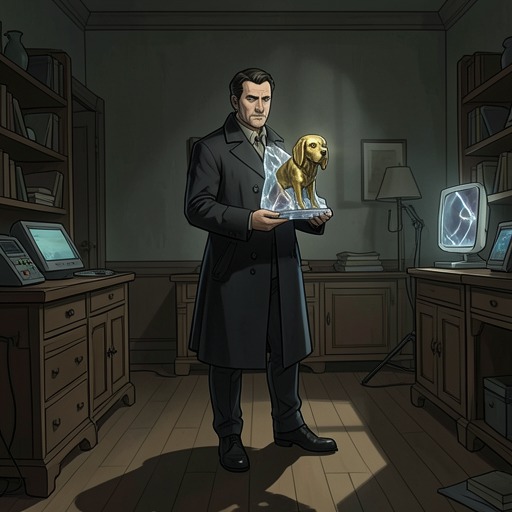
The crisis begins when Fenton Prentice receives a telephone call from the person then in possession of the Carpathian Hound. The caller claims to have found a place where the sculpture can be sold and offers it to Prentice for ten thousand dollars. Through a microphone and loudspeaker assembled from an old radio, Jupiter Jones and the other investigators hear the art collector report the demand. The news catches Jupiter off guard: the call confirms that the sculpture is not merely missing but being held for a price.
Prentice considers the proposed payment a criminal transaction, yet insists that the Carpathian Hound is his and fears that refusing could mean losing it forever. He says he has two days to gather the money. When asked whether he has notified the police, he refuses: he believes police involvement could frighten the burglar away and leave him without any chance of recovering the sculpture. His decision makes the negotiation a private risk, while the investigators look for a way to intervene without relying on a straightforward exchange.
The marked parcel and the five o’clock drop
Jupiter’s plan separates the apparent ransom from real money. He cuts a day-old newspaper into small pieces roughly two inches by five inches, shaping the rectangles to resemble bills. Since Prentice already knows where the Carpathian Hound is, Jupiter reasons that a real payment is unnecessary. The investigators instead need the parcel to reveal the identity of whoever collects it.
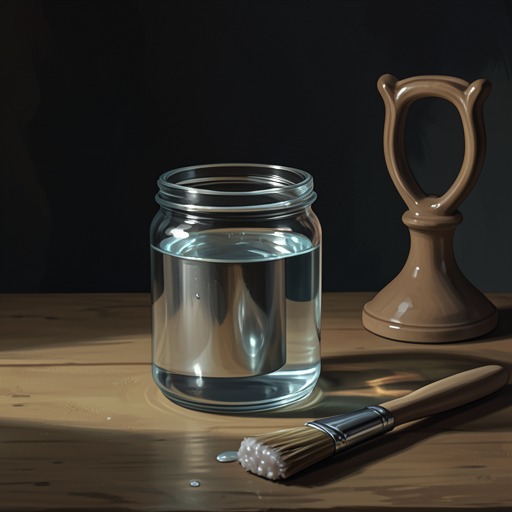
Jupiter treats the imitation money with his special ointment, which will leave indelible black spots on a person’s hands, and applies more to the outside of the package after Prentice wraps it in brown paper. He advises Prentice to wear old gloves to avoid contaminating his own hands, and to contact the police so they can watch the park. Prentice raises a practical complication: people sometimes search waste-paper bins, so an unrelated passerby might take the package. The plan depends not only on marking the recipient but on identifying the right recipient among those who might approach the bin.
A typed, unsigned letter arrives in Prentice’s mailbox. On plain white bond paper, it orders him to wrap the money in brown paper and leave it in the waste-paper basket at the entrance to the park at exactly five that afternoon. The envelope bears a postmark from the previous day. The precise time becomes more than an instruction for the exchange: in retrospect, it is the clue that distinguishes the real burglar from Alex Hassell. Hassell observes Five o’clock cat-feeding time; an absence at that hour would have been noticed, making the scheduled drop inconsistent with his routine.
At almost five, Prentice walks down the street with the parcel, looks around, places it in the overflowing bin at the park entrance, and returns up the street. A ragged man then rounds the corner from Wilshire. His coat is pulled up to hide that he has no shirt, and one trouser cuff is torn. Nearby, a maintenance man stoops over something on the grass while a news vendor counts his papers. The shabby man probes the bin, takes the brown parcel, and conceals it under his coat. The vendor and maintenance man run toward him. The disguise and the quick concealment make the pickup look like the work of a vagrant, but Jupiter does not treat the sight of a parcel in the wrong hands as the end of the inquiry.
The hospital alibi exposed
When police officers are ready to pursue the man at the park, Jupiter stops them. He says that he knows where the burglar is and that the man will not try to hide, because he has a perfect alibi. Jupiter directs the officers to the Belvedere Medical Clinic, only a few blocks away. The reasoning turns the apparent obstacle—the suspect’s absence from the scene—into the central part of the solution.
At the clinic, John Murphy is in bed in a large corner room, with the covers pulled to his chin and a television playing opposite him. Harley Johnson, his nephew, sits at the foot of the bed, regarding him with both amusement and disapproval. Murphy reacts angrily to Jupiter’s arrival, saying he has already endured enough lecturing from Harley. Harley answers with a mordant observation about smoking and Murphy’s health. The exchange presents Murphy as a patient receiving family attention, but Jupiter asks whether the ransom parcel is in the closet or under the bedclothes.
The parcel is in the closet, still sealed. Murphy sits up, his face flushed and his breathing raspy; his covers slip to reveal the tattered jacket and bare chest that match the ragged disguise at the park. Jupiter explains that even if Murphy had disposed of the parcel on the way back to the clinic, the ointment would still expose him: his hands would soon be covered in black spots. Murphy looks down at his hands. A sergeant steps forward to advise him of his right to remain silent, and Murphy says he knows his rights, will get dressed, and wants to call his lawyer. The sealed parcel, the matching clothes, and the chemical trace make the supposed alibi collapse into evidence of the pickup.
The staged injury and the motive
The arrest also resolves why Murphy seemed to be safely hospitalized while the ransom was collected. Jupiter identifies the fire in Murphy’s apartment as something Murphy set himself to create an excuse to be in the hospital. The timing mattered: between Christmas and New Year, he expected few patients. Once he had learned the nurses’ routines, he could slip in and out while they were not watching him closely, believing he needed sleep. The private clinic therefore did not prevent the crime; Murphy used it as cover for leaving and returning without drawing notice.
The later explanation makes the ten-thousand-dollar sum legible. As Harley’s guardian, Murphy had borrowed money from Harley’s account for his own stock-market speculation and lost it all. Harley would come of age the following month, when Murphy would have to account for the missing funds; Jupiter explains that disclosure would send Murphy to jail. Murphy therefore needed the ransom money to replace what he had taken. The scheme joined a stolen sculpture to a separate breach of trust: the ransom was not simply a bid for profit but an attempted repair of an account Murphy had already depleted.
The revelation also settles the question of the burglar’s identity. The five o’clock instruction rules against Alex Hassell, whose cat-feeding routine would make his absence conspicuous; the marked package and the evidence at the clinic point instead to Murphy. Harley has forgiven his uncle, but the account of the case leaves the legal consequences to the courts. Murphy’s arrest thus ends the investigators’ identification problem without erasing the harm behind it: the money was sought to conceal a prior misuse of Harley’s funds, and the hospital refuge that seemed to establish innocence was part of the deception.